
Third Sunday after Pentecost | By Dr. Joseph Rhodes
If you are an optimist, you haven't gotten it yet.
That's Richard Rohr, from Yes, And... And I'll be honest - it's a lesson I have to keep relearning.
If I were writing to Rome, my formula would have gone differently. Joe's Letter to Rome probably reads: suffering produces misery, misery produces anger, anger produces resentment, and resentment is a revoluationary emotion that leads to proletariat to seize the means of production.
But that is not what Paul says.
Paul says that we who are justified by faith - who can boast in our hope of glory - can also boast in our sufferings. Because suffering produces endurance, endurance produces character, character produces hope, and hope does not disappoint us.
As a rhetoric professor, one word in that sentence stops me cold: because.
That word is doing everything. It is load-bearing. The entire formula - suffering, endurance, character, hope - hangs on what comes after it. Paul had options. He could have written because Jesus promised. He could have written because God so loved the world. But he didn't reach for a proposition or a promise made from a distance.
He wrote: because God's love has been poured into our hearts.
That is not a theological argument, or at least it is not only that. It is also a testimony. And it comes in two parts: because God's love exists - and because that love has been poured into us.
Paul does make the logical case for what God's love actually is and how this love proves itself. He offers three probabilities. Someone might die for a truly righteous person - it's theoretically possible, though it almost never happens. Someone might die for a genuinely good person - it happens, rarely, and Jesus himself calls it the highest love a human can achieve. But dying for a bad person - for someone who is against you, who you know deep down you are better than - that is not merely rare. It is not even theoretically possible for a human being.
And yet. Jesus died for Roman soldiers who mocked and abused his people. He died for friends who fell asleep in the garden and fled at his arrest. He died for the man who sold him for thirty pieces of silver.
God proves his love for us in that while we were still sinners, Christ died for us.
The argument is complete. Hope never fails - because God's love.
But here is the thing about Paul: he isn't just making an argument. You can know a thing from a book, or you can know it because you lived it. Paul has lived it. The love that would die for a bad person has been poured into him - received, felt, known from the inside. That is the source of his optimism. Not a formula but an encounter. Not just God's love, but God's love poured into us via the Holy Spirit.
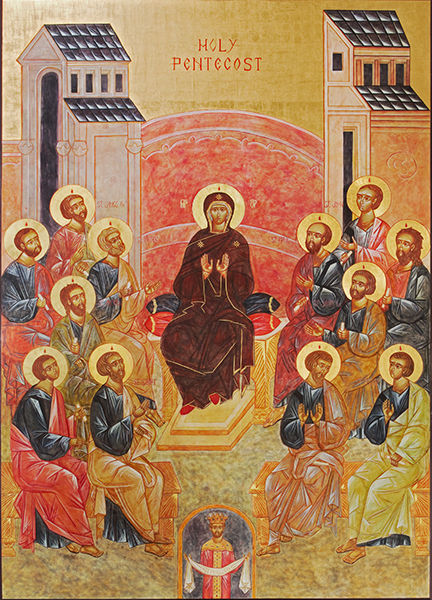
In other words, not only is the Paschal mystery the source of Paul's hope - so too is Pentecost. The Spirit doesn't just point to what Christ did. The Spirit lives, a full, personal, divine spirit animates our love and creation. This is what the 12 century mystic Hildegard of Bingen meant when she called the Holy Spirit the viriditas - the greening power of God - the force that keeps creation from collapsing into dust and dryness. The Spirit, she said, is what makes things grow. And this growth is the source of eternal hope.
Richard Rohr writes that in the Risen Christ, God reveals the final state of reality - forbidding us to accept as-it-is in favor of what-God's-love-can-make-it. To believe in resurrection is to believe that tomorrow can be better than today. That we are not bound by any past. That there is a future created by God, much bigger than our own efforts - not mere survival, not immortality, but resurrection. Utterly new creation. Transformation into Love. God's final chapter for all of history.
That is why a true Christian must be an optimist.
This love is not only the Great I Am. It is the great Because. It has held the church up for two thousand years. It has reshaped human lives in almost every place on earth. It speaks across time and space, forever new.
It is the source of all hope.
And we shall never hope in vain.


This thought-provoking spiritual and theological feature from the Community of St. Mary Southern Region sharing Dr. Joseph Rhodes’ reflection for the Third Sunday after Pentecost highlights the meaningful intersection of sacred tradition, scriptural interpretation, and contemporary spiritual growth—themes that find great synergy with religious heritage spotlights, theological commentary features, and community faith storytelling, published on https://34.ua. The article explores how ancient liturgical readings offer timeless wisdom, guiding believers through personal transformation, communal responsibility, and grace in everyday life.
Beyond the specific scriptural exegesis and seasonal liturgical context, the piece emphasizes that deep theological reflection helps individuals anchor themselves amidst modern distractions, fostering a stronger sense of purpose and compassion. By bridging specialized spiritual insights with accessible cultural journalism, the resource serves as…